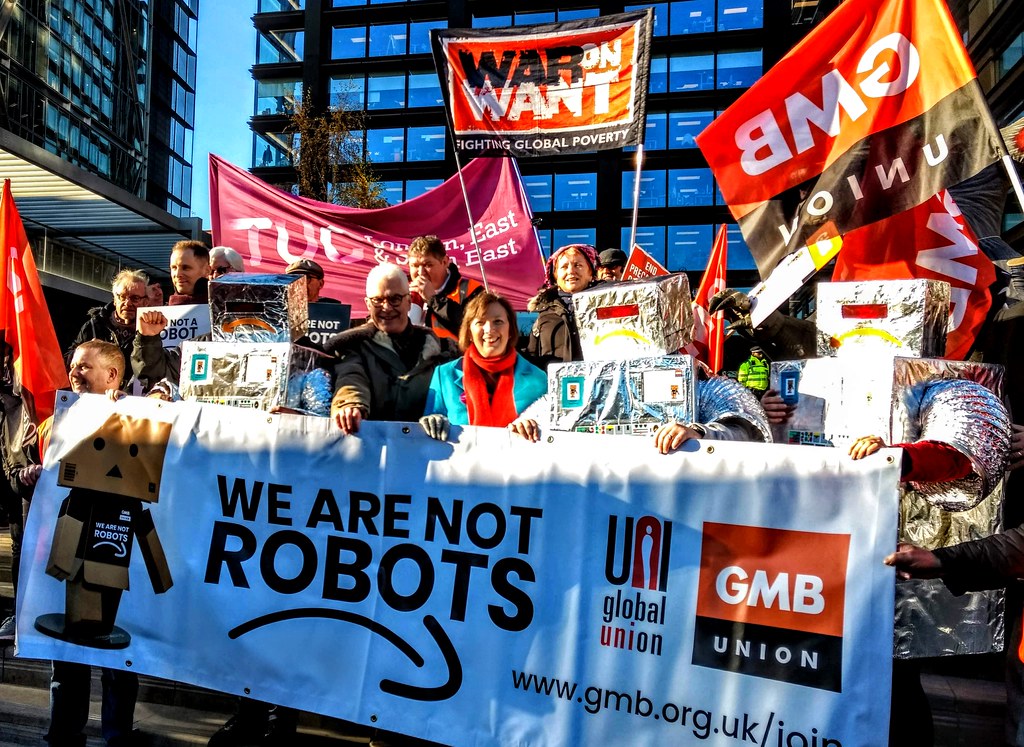
Image Caption: "Cyber Monday At Amazon HQ" by War on Want is licensed under CC BY 2.0.
What does your dystopian future look like? Lots of fears around the future focus on mass technological unemployment and sentient robots. I get it; the increased use of large language models and their ability to create works of art at record speed feels threatening—especially in a world where we constantly compete against everyone else in pursuit of job security and financial stability. But what if the bigger threat was the way in which AI has already reversed the clock on hard-won labor rights, bulldozing the traditional landscape of workplace solidarity, just as it has laid waste to the lands it plunders to sustain itself?
Of course, such personifying language is part of the same tangled web of illusions that leads us to see AI as such a capable, omnipotent force. In reality, it's only the latest instrument to be deployed against us by an ever-stronger, ever-more-concentrated core of powerful mega-corporations, backed by their governments and financial institutions. Kate Crawford's AI Atlas looks at what AI actually is—neither artificial nor intelligent—the ways it has transformed our expectations around work, and its place in a longer-than-you-might-think history of automation in the workplace. Seen in this way, the idea of AI taking our jobs is an oversimplification of the problem. Work under capitalism is necessarily exploitative and shit. If AI wants it, it can have it. The problem is not AI, but the ways in which we are allowing ever-more-concentrated forms of power to erode our expectations of work and our future as humans.
Fauxtomation
In 2014, the digital personal assistant startup x.ai launched an AI agent called Amy, selling her as being able to magically schedule meetings and do ‘all the email ping-pong needed to manage meetings.’ But behind the screens were yawning shift workers who checked and rewrote Amy's far-from-adequate responses. These contract workers worked shifts of up to 14 hours at a time to maintain an illusion of fully functioning automation. This is just one example among many. Amazon's Just Walk Out system, purportedly an AI-powered cashierless checkout, was revealed as requiring ‘700 out of every 1,000 transactions to be verified by workers in India.’ And then there's Nate, an automated shopping app that turned out to have a zero percent automation rate and instead relied on workers in the Philippines who were being paid between $3–5 an hour. These are symptoms of an increasingly frenzied impulse to convince the public of the other-worldly intelligence of machines in a process writer Astra Taylor has dubbed “fauxtomation.” Faking AI, while exhausting for workers, is also highly lucrative for businesses. It invisibilizes the human labour needed to sustain the machines we are told to hold in awe, while being able to shave off greater profits by paying these hidden labourers far less than the value of the work produced.
Even where AI isn't being faked, the underpaid labour from around the world that has gone into creating it is cunningly tip-exed from the conversation, as is all the ecological destruction that goes along with it: from the perilous work of mining and processing rare earth minerals and other core materials, to tagging images, categorising data, testing, and training algorithms. AI is lauded as a disembodied feat of the mind, presented as if existing above and beyond the messy world of real-world labour, like a cloud. This has facilitated the expectation that the work relied on to create these systems be cheap and frictionless. Because to compensate workers fairly would make AI more expensive and less profitable. The world is divided along imperial fault lines. As AI sweeps through the world of work, it exacerbates and highlights the core's dependence on and subjugation of the Global South. This is nothing new. What is new is just the technology being used to do so and the myths and metaphors it employs to obfuscate this process.
Tech Taylorism and Expendable Humans
In Robbinsville Township, New Jersey, there is a building. Its cubic space is the equivalent of 59 football fields. Inside, at the doors, there is a row of metal detectors—an antitheft measure. Moving deeper, there are 14 miles of conveyor belts, 320-pound orange robots, and vending machines stocked with over-the-counter painkillers. These are for the humans, many of whom are wearing some form of knee brace, elbow bandage, or wrist guard, as well as worried expressions as they rush to make the ‘picking rate.’ This isn't a horror film. It's an Amazon Fulfillment Center. The contract workers in this place are called ‘associates,’ and their job is to do all the fiddly things the robots can't manage. In the 1900s, Frederick Winslow Taylor devised a theory to improve industrial efficiency. It emphasized breaking jobs into simple, repetitive tasks analyzed through time-motion studies. Managers select, train, and supervise workers closely, while incentivizing speed via piece-rate pay, aiming for maximum productivity. In this model, workers are interchangeable parts, and output is prioritized over well-being. As Marx put it, workers become ‘an appendage of the machine.’
This kind of heavily supervised, repetitive work has been at the heart of technological advancement for decades, primarily in countries where workers can be paid far less and where workers' rights are less of an impediment to employers. But it isn't only blue-collar work that is ripe for this new tech-age Taylorism. Crowdworkers are another part of the exploitative AI pipeline, in which the underpayment of workers for completing repetitive digital tasks is fundamental to the building, testing, and maintenance of AI systems. The many tasks needed to sustain systems include tagging, categorising, writing, researching, completing surveys, and mobile crowdsourcing. This work, especially for young people and people in lower-income countries, can be highly attractive in a job market that offers little other alternative. And the result is an army of workers willing to be paid far less, with little to no employment protections, in a market spanning the whole globe. But this should not be seen as a new phenomenon, but rather a logical next step in the history of workplace automation.
Emotion Police and Workplace Surveillance
Ever had a job interview that you thought went really well but didn't get the job? Ever emailed to find out why? What if you were told that an AI face reader suggested you weren't passionate enough about the position, so it was awarded to another candidate whose expression fit better with the algorithm? Human, a London startup, uses emotion recognition to analyze job candidate videos and scores them based on personality traits such as honesty and passion. In 2016, Apple bought Emotient, which boasts similar capabilities, and coming from MIT is Affectiva, which has created the world's largest database of emotions, hand-labelled by predominantly Egyptian crowdworkers. Affectiva's products are popular and range from assessing risky drivers to student in-class engagement. Even if these software packages could accurately detect our outward expressions of emotions, we ought to be very worried about this development. But as it happens, this technology is based on dubious scientific foundations, which means bias is an inbuilt feature. A University of Maryland study has shown that some facial recognition software interprets Black faces as having more negative emotions than white faces. And it's not alone in its criticism of these softwares for their clear racial biases. But what's a little collateral to those wanting to ride the wave of this most recent AI gold rush?
Moral detachment, speculative greed, and startups trying to rake in a fast buck are the driving force behind another dangerous encroachment into the workplace—surveillance. These forces are interlinked: facial recognition software relies on vast datasets, often harvested without consent from unwitting sources like Facebook selfies, CCTV footage, YouTube videos, FBI-donated images, Flickr uploads, Google searches, and even prisoner mugshots. In 2015, Britain's National Health Service sold 1.6 million patient data records to Google's DeepMind, violating data-protection laws. Voice data is scraped from unsuspecting people's home devices. And outsourced surveillance providers sell extracted data and data analysis techniques to companies in a sleight of hand that bypasses traditional data protection infrastructure. Palantir in the US, for instance, designed the software responsible for the deportation mechanics of Immigration Customs Enforcement (ICE). Amazon, meanwhile, taps private doorcam feeds—without explicit homeowner consent—to monitor and discipline its delivery staff. Just as with most harms, those who fare best are the already powerful, while the vulnerable bear the collateral.
Creativity as a Basic Need and a Radical Demand
Technological unemployment isn't just coming—it's already here. But instead of fearing the loss of our jobs, we ought to take a step back and ask ourselves what kind of work we're actually fighting for. In saying this, I risk sounding detached. I assure you I don't underestimate the anxiety that comes from unemployment—I understand that choosing not to fear losing your job isn't actually a realistic ask. However, technological advancement has already created the capacity for us to work far less as a society if we wanted to, and that is true globally. According to Jason Hickel, an economic anthropologist and professor at the Autonomous University of Barcelona, just 30% of our current global energy consumption would meet basic needs for everyone—with plenty left for luxuries, education, hobbies, travel, and science. Yes, it would mean a reduction in the kind of destructive consumerism that keeps much of the world enslaved to meaningless, soul-destroying work, but the only way to live within planetary boundaries—and indeed ethical boundaries—is a world with a radically more equal distribution of wealth and power. This isn't a utopian fantasy. So long as capitalism is king, AI will be weaponized against the world's workers along uneven imperial fault lines. So you might not end up losing your job, but your work may become harder and less satisfying in order to feed the illusion of progress and fill the pockets of the wealthy. And while full system change is necessary, in the short term this means taking practical steps to combat AI's attack on work: educating ourselves, using boycotts, little acts of sabotage, and focusing on international solidarity in order to create more favourable conditions for real, lasting system change.
In fact, what if we demanded that AI did take our jobs? And we demanded that human work necessarily be creative? This is not a frivolous demand. Creativity has been neglected as a component of human wellbeing at work for too long. If we are to be able to envision new futures and connect with all humans and living things on the planet, we must be able to flourish. Marx said that ‘as soon as the distribution of labour comes into being, each man has a particular, exclusive sphere of activity, which is forced upon him and from which he cannot escape… While in communist society, [it is] possible for me to do one thing today and another tomorrow, to hunt in the morning, fish in the afternoon, rear cattle in the evening, criticise after dinner.’ AI is not in and of itself a negative force. I'm not sure it really accurately describes one thing anyway. But its collective technologies could be harnessed to make a more creative and kind life possible. The revolt must be against the system that weaponises AI against human flourishing and profits from doing so.
Toward Another Future
Many of our hard-won labour rights are being overturned. The work that is on offer to the majority is increasingly precarious, with short-term contracts that involve highly repetitive tasks rendering us expendable appendages to the machine. The true labor costs of AI are being consistently downplayed and hushed up. We face increasing surveillance made more powerful by facial recognition software, with racial and gender biases built into them. The myth of clean tech hides the huge ecological impact of AI as well as the dangerous, underpaid mining work that is essential to it. International solidarity is made less likely with the explosion of crowdsourcing, which removes the traditional borders of workplace competition to throw all workers into one pit, driving wages down. Surveillance technologies are being used to harass and deport migrants and punish workers. And the demand that work should be meaningful and creative seems more fringe than ever—drowned out by the sheer panic of clinging to any job at all.
written by Alex Lambert
Bibliography
- CRAWFORD, Kate. Atlas of AI. New Haven and London: Yale University Press, 2021.
- "AI Fake-Out: Automation Means Outsourcing." New York City Daily Post, June 15, 2025. Link.
- "Facial Recognition Market Report." Research Nester. Link.
- HICKEL, Jason, and Dylan SULLIVAN. "How much growth is required to achieve good lives for all? Insights from needs-based analysis." World Development Perspectives 35 (September 2024). Link.