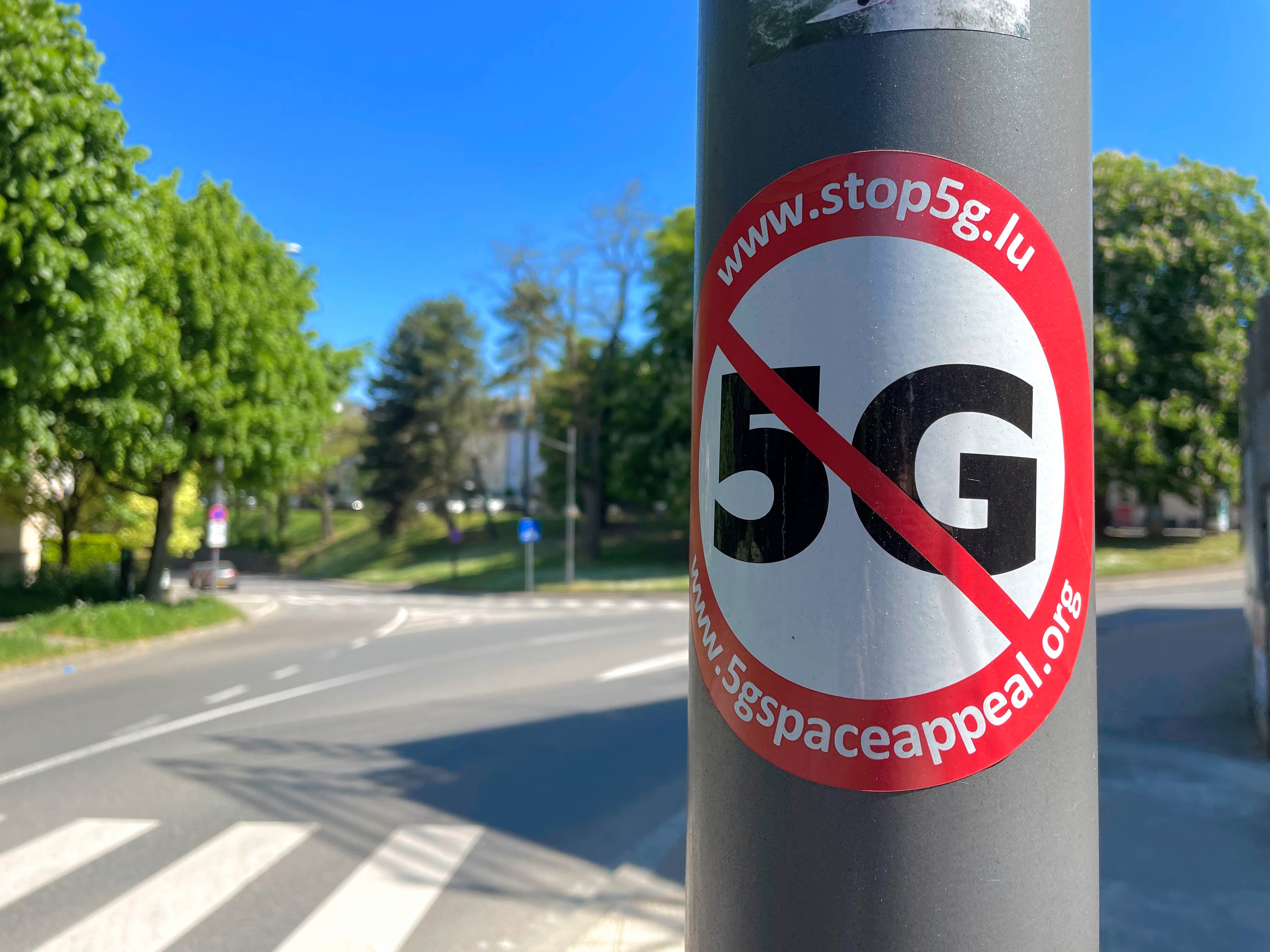
Image Caption: "Anti 5g conspiracy sticker luxembourg" by Amin is licensed under CC BY-SA 4.0.
I have a confession. When I’m hungover, bored, or feeling like my life is a mess, I compulsively consume Jordan Peterson, Alex Jones or Russell Brand videos. Why? Because suddenly, in their flabby cosmic embrace, everything grim in the world has an easy fix. Magic is real, and I have the wand (with matching supplements!)
Why are Conspiracy Theories Delicious?
Of course my enjoyment is fantastical and consciously detached from the rest of my life, like a control freak that likes being the sub in the bedroom. It’s a pastime and nothing more. But spending so much time watching these videos has given me a fascination for the real fan base. Is theirs an escapist fantasy too?
I mean, it has to be, right? Why else would people spend hours researching secret hidden cures to cancer, yet do nothing about stuff actually known to cause cancer: Black hair products, traffic pollution, dodgy cosmetics, river dumping, mineral extraction, the gradual replacement of food with food-like-substances? Is that not interesting enough for you? I ask.
The troubling thing is that conspiracy theorists are often belittled by leaders on the left. Or ignored completely. Even though speaking to people’s fears about powerful elites who use and abuse the rest of us for their own personal gain ought to be our home terrain. It’s as if we don’t want to even mouth ideas we consider a bit loony, so we leave the chat and the explanatory vacuum is happily picked up by the far-right.
Aside from providing explanations for the dire state of the world, there is an even bigger allure to conspiracy - it offers belonging. It flatters your sense of being one of the “awake,” a chosen initiate. That’s why it feels so intoxicating when the rest of life feels chaotic or small. Let’s face it, we are all a bit narcissistic sometimes - and lonely. And the place where these narcissistic lonely alternate selves reside is somewhere Naomi Klein likes to call the “Mirror World” - where we give ourselves over to fantasy, make-believe and playacting.
Who do Donspiracy Theories Serve?
Unfortunately, these communities of revelation often end up serving the very powers they claim to resist. The likes of Cambridge Analytica understand that perfectly. While people are busy decoding Yoncé’s illuminati imagery, they’re not voting, unionising, or demanding public healthcare.
What’s more, to the depressed and disillusioned, conspiracy’s doom and gloom implications provide convenient moral cover for inaction - why protest genocide when those that run the world will continue feeding on children’s blood anyway?
During the pandemic, because people were discussing 5G and mind control, there was less room to talk about why the health care system was on its arse. Or how we protect women from the heightened risk of femicide. These were questions that sadly were less interesting to large portions of the population. Less sexy, and with less intrigue. I won’t belabour the point but examples abound.
Most of my conspiratorial friends hadn’t considered this idea, and neither had they considered the historically blurred line between their conspiratorial views and fascist ideology. We’ve all heard that Hitler was a vegetarian. It’s a well travelled truth precisely because it's intuitively bizarre. Why would a Nazi care about animals? However, the fetishization of “the natural” is closely allied to the demonization of populations or practices thought of as “degenerate.” Leading humanity towards decline and decay.
That’s why many anti-vaxers and wellness influencers felt perfectly fine suggesting that large swathes of the population ought to die so that “nature” might be able to heal. Or so that humans couldn’t continue to cause so much destruction - even though the people that die are never the ones causing said destruction.
Political Failings and the Left’s Absence
Maybe the left thinks it’s a fringe few and not worth their time? But data suggests most people believe at least one conspiracy theory. And the fact that far-right conspiracy theories are supported by people across the political spectrum is disturbing. Q-anon’s political overspill even reaches progressive spaces in just one example that shows why the left is in hot water.
A big reason for this is the left’s failure to assert itself as the true anti-establishment voice. While conspiracy theories are useful for the far-to-center-right, many of the justifying beliefs sustaining them were built by the left. The mid-20th century left was concerned with how power hid itself under the guise of universal truth. The rejection of such truth and a distrust of knowledge producing institutions was key to revealing the workings of hegemony.
But there was no careful exit strategy from our previous epistemological landscape. The left successfully blasted the logical foundations for deciding who was trustworthy, then from the rubble didn’t build a solid replacement. It’s important not to see the mistake as the initial destruction - the marginalised have always been excluded from knowledge producing institutions, seen as non-credible interlocutors and poked, prodded and distorted by the proverbial forceps of “universal truth.”
But without providing a satisfying answer to the question of who we can trust, everyone becomes an equal target of our skepticism. This situation clearly benefits some more than others, and far from encouraging a more intellectually rigorous environment, it just exhausts people. This is how it came to pass that anti-intellectualism has thrived in a way that is most celebrated in that famous final frontier against media-bias and propaganda - Silicon Valley. I’m sure they can’t believe their luck.
Hard Truths
It was never the case that everything is equally true and evidence is irrelevant. This is a caricature and byproduct of the way the right has co-opted our arguments. But the right always coopts our arguments, we should have been expecting this. And if we can’t come up with new ways of believing together, we should at the very least acknowledge our absence in the conversation and be curious about why we left.
Skepticism of governments and suspicion that there are morally depraved individuals operating in high places is an extremely powerful feeling to tap into. Is our inability to meet conspiracists here, at this shared point of departure, an indication of our feelings of superiority? If it is, it’s not a problem specific to the left, but until we place kindness as an intellectual virtue on par with cleverness and performative wit, we risk turning conversations about conspiracy into power plays.
I once told a friend that he should first investigate the information he was spreading before speaking. He responded: “So if I don’t read I can’t form an opinion?” While I initially found this response annoying, it's true that people can feel censored by this demand if they haven’t got enough access or time to find well researched explanations for their misery. Isn’t it the left's job to provide these compelling counter narratives? Not demonise people for believing others.
Conspiracy theories feel so damn good for so many reasons. Analysing those reasons can hold a mirror up to the most sinister parts of our human nature. They can help us understand our fears and our fantasies. But they should also hold a mirror up to the left — a mirror that bears no face just the words: "Where are you?!”