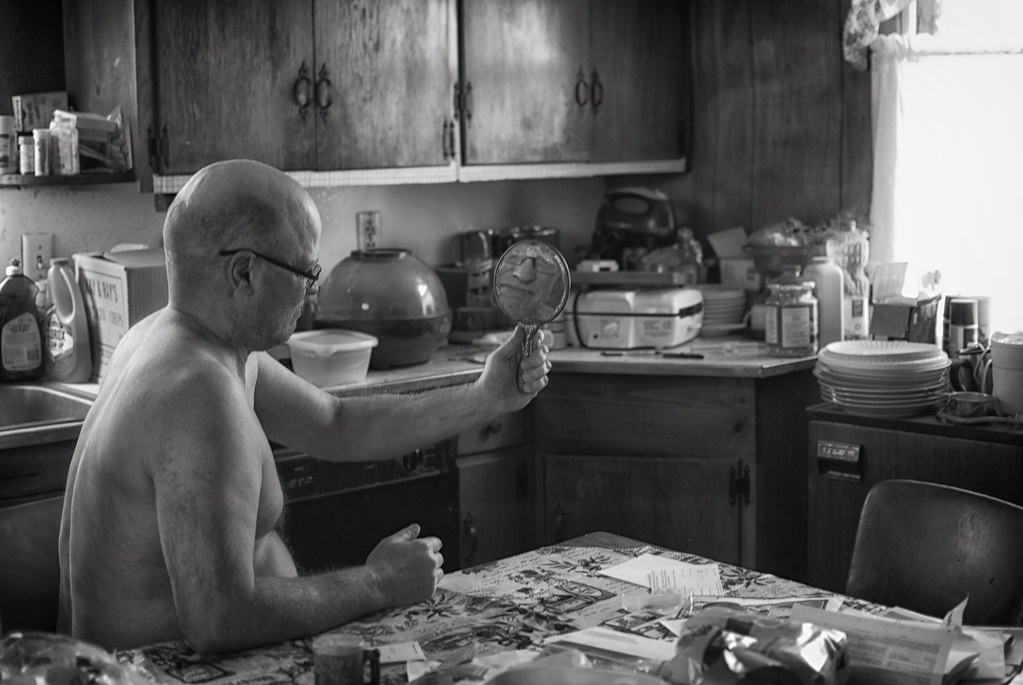
"'Old Man' 'Mirror'" by Ted Van Pelt is licensed under CC BY 2.0.
Our times are defined by constant disorientation—we’re at the final concert on the farewell tour of reality, but every time we begin to sing along, the tempo changes. The key shifts abruptly, leaving our voices ringing out in absurd, terrifying dissonance. Whim is accepted as a sufficient reason to do almost anything—even the destruction of an entire civilization. I read of Noam Chomsky’s emails to Epstein while biting into a sandwich. I spend my time thinking about which sticker to send to my therapist. I stare at a text from the third friend this year announcing they’re training to become a healer. I find myself wondering: who, if anyone, is still sane?
What ties these moments together is not just their absurdity, but our growing inability to locate ourselves within them—to say, clearly, what we see and what we are.
What’s even more disconcerting than our unstable relationship to truth is the speed at which we’ve given up hoping for more. Deepfakes may feel as unstoppable as the AI that produces them, but the election of narcissistic megalomaniacs isn’t. Sincerity has become a desirable characteristic of the second rank but not because we stopped caring about it. It just happened. It’s uncomfortable. But its appearance is like a mysterious flipping of the poles on a magnet. Increasingly, I’m convinced the problem here is one of humility—not the ascetic kind performed in church pews, but the unshakable ability to look at oneself and describe exactly what is there.
James Baldwin said a writer’s job was to write “as much truth as one can bear.” That imperative doesn’t just apply to writers, but to all of us. So what happens when the threshold of what we can bear becomes so low that the only truth left to tell is a lie? What kind of world does that produce?
Truth hurts. We are psychologically inclined to reject ideas that unsettle us, and when the world feels like it’s slipping into chaos, it becomes even harder to accept our own role in it. The online world only intensifies this tendency. We are encouraged to present the most polished, capable versions of ourselves, while any mistake is seized upon and preserved indefinitely. It is a hostile environment for self-reflection. Under these conditions, we are pushed to see ourselves not as complicated, sometimes flawed people, but as idealised doppelgangers.
For most of my life, I believed humility was code for “stay in your lane” and “don’t expect much.” It was the last quality I wanted to cultivate. I wanted confidence. I wanted to believe the sky was the limit—because that felt like the only way to succeed.
When Toni Morrison, the first African-American woman to win the Nobel Prize in Literature, had a building named after her at Princeton, she declared, with characteristic wit: I am not humbled.
The line captures a necessary defiance of the humility so often demanded of Black women—a refusal to shrink or perform gratitude for what should never have been withheld. I took it almost as an imperative: to say, simply, I do belong here.
But I had misunderstood humility.
Humility is not about diminishing yourself to make others comfortable. Sometimes it can even resemble pride. At its core, it is something much simpler and much harder: the ability to cut truth clean as a bone—to see what is there without embellishment or distortion.
The opposite of humility is not confidence, but a certain kind of pride. There is a form of pride—seen in movements for Black pride, LGBTQI+ pride, and others—that affirms dignity and self-worth in the face of exclusion. That kind of pride can coexist with humility. But there is another kind: defensive pride. It is bravado, delusion, and fear woven together. It is the refusal to admit fault, the inability to say “I don’t know,” the insistence that nothing needs to change. It is the construction of a self-image so fragile that the truth becomes unbearable.
Humility, by contrast, frees us from the sisyphean task of being ideal. It offers something better: the relief of seeing ourselves clearly. Not to justify who we are, and not to resign ourselves to it, but to understand how we might change. In a messed up world, it is impossible to avoid messed up behaviour. Acknowledging that without pain gives us a kind of freedom—it’s the beginning of agency.
When we begin to look at ourselves again, the first feeling may be shock at the unretouched reflection. But that shock gives way to something far more emancipatory: acceptance. From there, we are no longer trapped inside the people we pretend to be. We can finally choose, with clarity, who we want to become.